The novel
They have always known how to play together. Now they must decide where they stand.
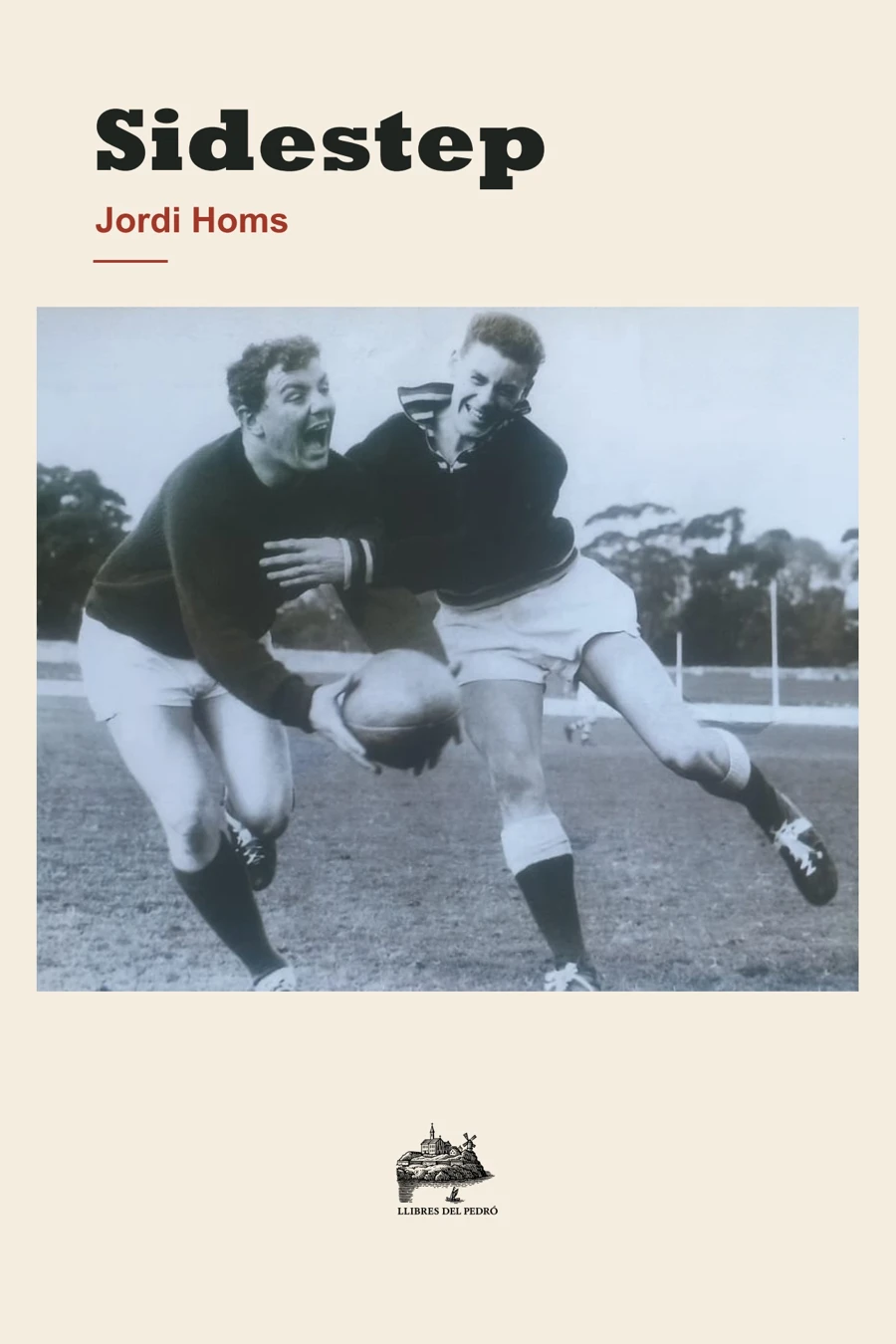
A sidestep can take a rugby player past an opponent. Off the pitch, a change of direction can put a friendship at risk.
Hèctor Fortuny, a team captain, and Pol Ferran, one of his most valued players, have spent their youth sharing a friendship and a belief in what rugby can mean. The game has shaped their lives and their sense of belonging.
Now in their thirties, they must confront the collapse of the world they believed in. The decision they face will place them on opposing sides for the first time.
Set in the Barcelona area at the turn of the century, Sidestep is a novel about loyalty, the bonds within a team and the need to adapt when familiar certainties fall away. This English translation brings Jordi Homs’s Canvi de peu, first published in Catalan in 2001, to a new readership. Published by Llibres del Pedró as part of its revised edition project.
Read an extract
When the body calls for change
After the match, in the changing room, Pol wonders how much longer he can keep playing.
Pol was left alone. He turned off the tap and wrapped the towel tightly around himself. His mind was blank, but he felt a quiet sense of well-being.
‘I’m getting old,’ he thought.
He rubbed himself briskly with the towel, walked over to the bench where his clothes were, and sat down with a sigh. For a moment, he stared into the distance and said it out loud.
‘I’m getting old.’
The Englishman had already left the changing room, and only Guillem Tort, one of the props, remained. He was also nicknamed Tortzenegger for his obsession with weightlifting and vitamin supplements. He was putting on his shoes at the far end of the bench where Pol was sitting.
‘What?’ he asked, wearing that permanently smug expression shared by all bodybuilders.
‘Yeah, Torto. I’m getting old. I’m thirty now, and it’s getting harder and harder to play.’
Guillem looked at him, astonished.
‘I’ll have to retire soon, before I start making a fool of myself on the rugby field.’
‘What are you talking about, man? You’re huge!’
‘“Huge,”’ Pol repeated, with a touch of irony. ‘I got sent off today, didn’t I?’
‘Bah! The ref was an idiot. And what about that scrum we did? What a hit, Pol!’
He shook his head, disappointed.
‘Yeah, now that I’m “huge,” as you say, I’d rather quit before my body starts its slide toward old age and my only weapon is throwing punches. This is the moment. I won’t drag myself on till I’m forty.’
Guillem laughed—a sincere but slightly dumb laugh. Pol gave him a strange look; he hadn’t meant to make a joke. Tortzenegger was like that. He was a good teammate, but hopelessly simple, with little grasp of irony. A typical prop. And sometimes that exasperated Pol immensely.
An extract from Chapter I. Jordi Homs · Sidestep · Llibres del Pedró.
This edition
- English translation of Canvi de peu, first published in Catalan in 2001.
- Part of the revised edition project from Llibres del Pedró.
- Available in paperback and Kindle editions.
Press on the novel
Reviews of the Catalan original, first published in 2001. Quotations retain the language of their sources.
«Desde “La media distancia” de Alejandro Gándara no había leído una novela deportiva tan competente. Qué agradable sorpresa.»1 de febrer de 2002 · Font i context
«és bona i ho serà molt de temps.»9 de novembre de 2011 · Font i context